"Our Google Ads specialist isn't delivering." That's rarely the right answer.
When the ads miss the target, the specialist often gets the blame. But an ad account doesn't work without tracking and a website that converts. Here's how we look at the business as one whole.
It's no longer about seeing the business as a set of separate units, where tracking, website, advertising and data are handled one by one. It's about seeing the business as one whole and building a setup that holds up in the future.
Most companies have one or more clear goals. The road there differs from business to business, and today there are hundreds of tools, channels and methods to choose between. That's why it's crucial that they work together.
Where it typically goes wrong: paid advertising
Paid advertising is often where companies put most of their faith. It's also often where the responsibility gets placed on one person: the specialist running Google Ads.
We've heard marketing managers ask several times: "Why aren't we reaching our goals, and what will it take?" The wrong answer is almost always: "Because the specialist is doing a poor job." The right answer is something a skilled specialist can dig out: insight into user behaviour, into demand and into which products should be in focus. That insight makes the whole organisation smarter, not just the ad account.
The traditional and the modern specialist
The traditional specialist's most important job is to run a platform within safe limits, keep the hygiene in order and fit in with a manager or coordinator. That's necessary work. But it's not enough.
For a long time the industry has split specialists into narrow roles: tracking, UX and CRO (user experience and conversion optimisation), tech, Google Ads, Amazon and so on. None of it works in isolation. An ad account doesn't work without a good website, and it doesn't work at all without correct tracking.
This is where we do things differently. Our job as modern specialists is to keep an eye on the whole and to be skilled in several areas that all strengthen our core area.
The road to third base
When we get a new client, we start the processes in the right order, without bureaucracy and long distances between disciplines. In many traditional setups the tracking specialist becomes a bottleneck for the ad specialist. Then the Google Ads account gets started up optimising towards clicks instead of the actual business goal, because the conversion tracking isn't ready.
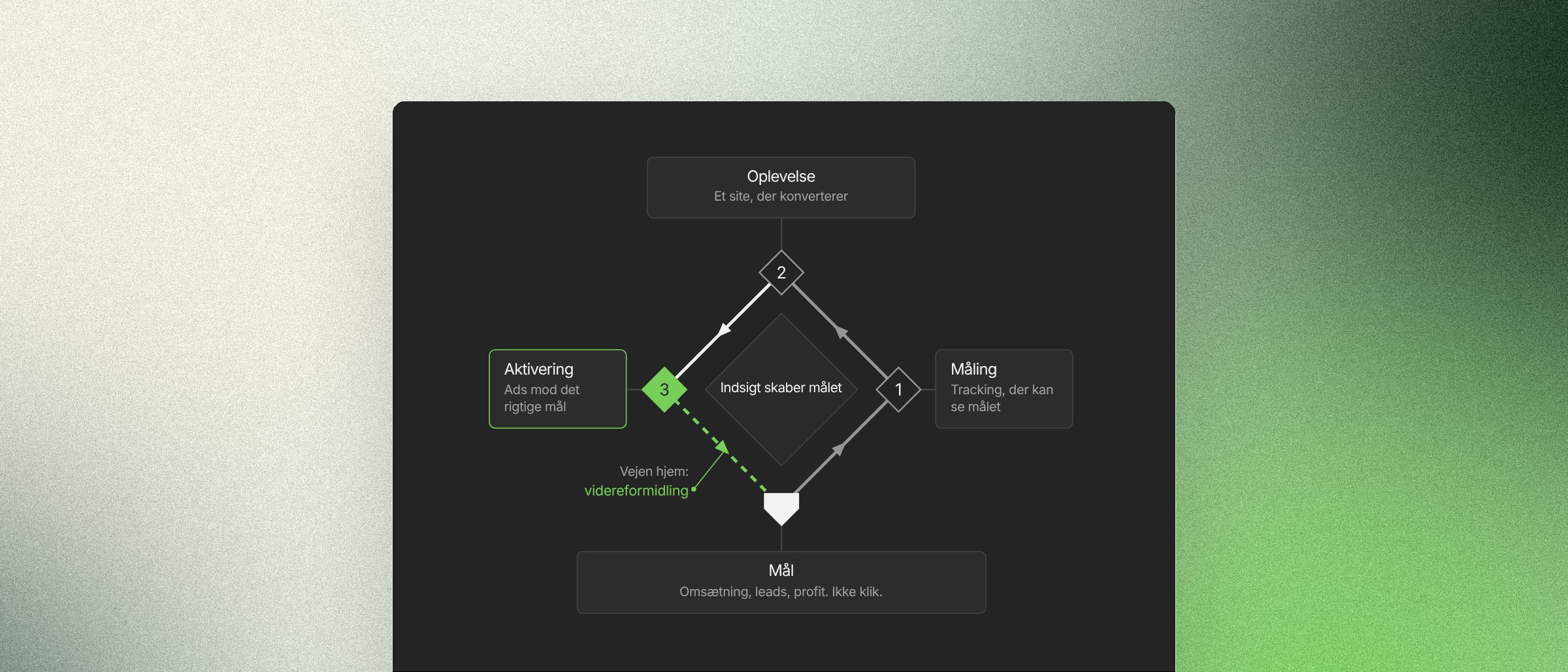
We think of it as a baseball diamond. The goal is home plate. That's where everything starts, and that's where you need to get home again.
The goal has no number, because it isn't a step. It's the reason you play. The steps are 1 measurement, 2 experience and 3 activation. Third base is the most important element besides the goal itself, and that's also where our name makes sense.
You only reach third base safely by having touched first and second.
The way home goes through dashboards that translate the results, so the whole organisation can see what works. Then the goal can be sharpened for the next round. When the bottleneck disappears, we have the client's goal in focus on every parameter from day one.
The hard part about silos: unlearning
The big problem with working in silos is that you learn to be in the silo. Afterwards you have to unlearn, and that's often harder than learning something new.
Fortunately you can learn very fast today. AI has become everyday in many companies. According to Eurostat, 42% of Danish companies used AI in 2025, against 20% in the EU as a whole. But not everyone knows how to learn from AI.
The best starting point is knowing the goal and the scope, even if you don't yet know the way. Then you work from your existing knowledge and learn the rest along the way. That way new learning quickly becomes a new core skill.
We steer AI. AI doesn't steer us.
The most important principle for us is simple. We don't let AI steer us, and we don't use AI as an autopilot. We steer AI. People set the direction and the limits, AI speeds things up, and people check the result. That's the only way to get results that are both good and accurate.
It's the same point we've written about in AI slop: why cheap content costs your brand. When AI is allowed to steer, the result becomes generic. When people steer AI, it gets sharper.
Why we can do it
Our strength is stubbornness and a real desire to adapt to the reality we live in. With AI as a tool, and not as a boss, we can cover more disciplines in depth than a traditional specialist setup can.
Working with us is about exactly that: working together. We get to know your business and build a tailored setup with full transparency. We're not tied to one platform. We can take the conversation with your CMO, marketing manager or other specialists, put ourselves in their shoes and ensure progress towards the goals.
And because not everyone speaks Google Ads, we build dashboards that translate data into a language even inexperienced users understand. Then the whole organisation gets the same picture of what works, and why.
Search at Thirdbase Google Ads, tracking and dashboards as one joined-up effort See how we work with paid search from measurement to the dashboard the whole organisation understands. See Search